


This week’s Solex LLC call was truly one for the books.
AO Scan founder and Solex president Loran Swensen joined the weekly update for an in-depth conversation about tuning forks, sound, vibration and the development of AO Tune.
Whenever Loran explains how an AO Scan feature came to life, I pay close attention.
Our AO Scan Global community includes users, practitioners, biohackers and wellness professionals in many countries and time zones. Not everyone can attend a weekly call or watch it when it premieres.
That is why we turn these important conversations into complete educational recaps.
Watch the recap on our AO Scan Global YouTube channel. AO Scan founder Loran Swensen explains how traditional tuning forks inspired AO Tune, how digital tones are delivered through transducers, and how physical and digital frequency tools differ.
We want AO Scan Global users around the world to stay informed, supported and in the KNOW.
This call deserves a deeper look because Loran explained:
- How a tuning-fork class inspired AO Tune
- Why physical tuning forks produce a consistent frequency
- The difference between weighted and unweighted tuning forks
- How steel, aluminum and crystal forks can sound different
- Why a physical tuning fork gradually becomes quieter
- How a digital tuning-fork tone can remain consistent
- How the AO Tune transducer delivers sound and vibration
- Why AO Tune can offer access to many tones without carrying a collection of physical forks
- How AO Tune may be used as a targeted or general frequency tool
The call also included new Solex promotions, Q3 incentives, Sample Pass information and another first-place recognition for AO Scan Global.
AO Answer: What Is AO Tune?
AO Tune is a digital frequency tool inside the AO Scan SEFI module.
It allows a user to select from a library of tones and deliver those tones through compatible AO Tune Bluetooth transducers.
A physical tuning fork must be struck to begin vibrating. Its sound and vibration gradually become softer as the mechanical energy dissipates.
AO Tune works differently.
The tone is generated electronically. Therefore, it can continue at a selected frequency and intensity for the chosen playback time without requiring the user to strike a fork repeatedly.
AO Tune is not physically identical to a steel, aluminum or crystal tuning fork. Instead, it is a portable digital system inspired by tuning-fork frequencies and designed to make a large collection of tones easier to access, select and use.
Why This Conversation with Loran Swensen Matters
Loran Swensen is not simply someone demonstrating an AO Scan feature.
He is the founder who helped bring AO Scan technology to life.
During the call, the hosts credited him with doing the early work, gathering the right people and helping transform the original concept into the broad frequency platform users know today.
What makes his approach especially interesting is that AO Scan development does not always begin with a preplanned product list.
Sometimes it begins with curiosity.
Sometimes it begins when Loran encounters another tool and asks:
Can this be simplified?
Can it be digitized?
Can it be duplicated in a practical and accessible way?
That is what happened with AO Tune.
How a Tuning-Fork Class Inspired AO Tune
Loran explained that he attended a professional convention for continuing education related to his naturopathic background.
He had already completed the classes he needed and noticed an elective course about using tuning forks in a wellness practice.
He decided to attend.
The instructor demonstrated how he used tuning forks throughout his work. He even began his day by activating a fork and walking through the room as part of his process for creating a calm and intentional environment.
At first, Loran recognized that this might appear unusual to someone unfamiliar with sound or energy-based wellness practices.
However, he also noticed that the atmosphere in the room seemed to change.
That experience captured his attention.
The instructor continued demonstrating different tuning forks and explaining why he selected particular tones for different purposes.
Loran left the class thinking:
There has to be a way to bring this into AO Scan.
He spent much of the next two days considering how the individual tuning-fork tones could be digitized and made available through the technology.
That curiosity eventually became AO Tune.
Pictured below is the AO Tune. “I describe the size of the AO Tune speaker as a double-stuffed Oreo, but with a much different outcome.” Paige Maurer Wheeler AO Scan Global
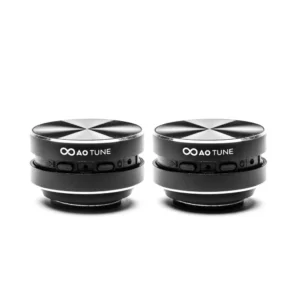
Shop for the AO Scan’s AO Tune that broadcasts digital tuning fork tones HERE
A Brief History of Tuning Forks
The tuning fork was originally created as a musical tool.
A physical fork provides a stable reference pitch that helps musicians tune instruments consistently.
Over time, tuning forks also became useful in hearing and neurological examinations.
Traditional clinical uses have included:
- The Weber hearing test
- The Rinne hearing test
- Basic vibration-sensation testing
- Certain neurological assessments
The familiar design is simple.
A tuning fork contains two parallel prongs, often called tines. When the fork is struck, those tines vibrate back and forth and produce a tone associated with the fork’s construction.
What Determines a Tuning Fork’s Frequency?
The intended frequency of a physical tuning fork is primarily determined by its design.
Important factors include:
- The length of the tines
- The thickness of the tines
- The shape of the fork
- The mass of the vibrating sections
- The stiffness and density of the material
- The placement of additional weights
Striking a fork harder may make the sound louder.
However, it does not normally change a fork designed for 128 Hz into a different frequency.
The stronger strike changes the initial amplitude or intensity.
The underlying intended frequency remains approximately the same.
Why Does a Physical Tuning Fork Become Quieter?
A physical tuning fork receives a limited amount of mechanical energy when it is struck.
As it vibrates, that energy gradually transfers into the surrounding environment.
Energy may move into:
- The surrounding air
- The hand holding the fork
- The body or surface touching the stem
- Internal friction within the material
- Other forms of mechanical damping
As the energy decreases, the vibration becomes smaller.
The fork may continue producing approximately the same frequency, but its volume and intensity gradually fade.
Eventually, it must be struck again.
This is one of the clearest differences between a physical tuning fork and a digital AO Tune tone.
Why an AO Tune Tone Can Remain Consistent
AO Tune does not depend on a piece of metal continuing to vibrate after a single strike.
Instead, the software generates a repeating electronic signal at the selected frequency.
The connected transducer converts that electronic signal into sound and vibration.
As long as the tone is playing, the device is connected and the volume is maintained, the output can continue without the natural fade of a physical tuning fork.
This gives the user a more consistent tone across the selected playback period.
The user does not need to reactivate the fork every few seconds.
What Is a Transducer?
A transducer converts one form of energy into another.
In AO Tune, the transducer receives an electrical audio signal and converts it into sound and mechanical vibration.
A conventional speaker typically moves a cone to push air and create sound.
The AO Tune transducer is designed to deliver the selected tone in a smaller, more direct and portable format.
The transducer can be held near the body or placed in contact with an appropriate area according to the user’s training, intended application and comfort.
Is AO Tune the Same as a Physical Tuning Fork?
No.
This is an important distinction.
AO Tune is not a steel tuning fork.
It is not an aluminum tuning fork.
It is not a crystal tuning fork.
It does not reproduce every mechanical characteristic of those physical objects.
A physical tuning fork has its own:
- Material resonance
- Weight
- Mechanical feel
- Natural decay
- Initial impact sound
- Overtone pattern
- Method of vibration transfer
AO Tune generates a selected electronic tone and delivers it through a transducer.
The primary frequency can be reproduced electronically, but the complete physical experience is not identical to striking a particular metal or crystal fork.
AO Tune should be understood as its own digital frequency tool.
Why Steel, Aluminum and Crystal Forks May Feel Different
Two physical forks can be tuned to the same fundamental frequency and still sound or feel somewhat different.
The material may affect:
- Density
- Stiffness
- Sustain
- Mechanical damping
- Overtone behavior
- Tactile vibration
- How vibration travels through the stem
Steel, aluminum and quartz-based materials do not respond mechanically in exactly the same way.
However, the stated frequency still refers to the number of cycles per second.
A physical 128 Hz fork and an electronically generated 128 Hz tone share the same named fundamental frequency, even though their overall sound and mechanical qualities are not identical.
Weighted and Unweighted Tuning Forks
Loran also explained the basic difference between weighted and unweighted physical tuning forks.
Weighted Tuning Forks
Weighted tuning forks have additional mass attached near the ends of the tines.
That extra weight generally creates a stronger mechanical vibration through the handle or stem.
Practitioners often use weighted forks through direct contact by placing the stem against a selected area.
The emphasis is more tactile and localized.
In simple terms, a weighted fork is often chosen when the user wants to direct vibration toward a specific contact point.
Unweighted Tuning Forks
Unweighted tuning forks do not contain the additional masses on the tines.
They generally create a clearer audible tone that radiates more strongly into the surrounding air.
Practitioners may hold or move them near the body rather than placing the stem directly against one point.
In simple terms, an unweighted fork is often used when someone wants the tone to fill the nearby space.
Can AO Tune Be Used in Both Ways?
The AO Tune transducer provides some flexibility.
When the transducer is placed in contact with an appropriate surface or area, the vibration may feel more localized and directed.
When it is held away from the body, the user receives more of the experience through airborne sound.
This allows the digital tool to offer experiences inspired by both weighted and unweighted applications.
However, the transducer remains an electronic device rather than a physical weighted or unweighted fork.
The Si Bin Surface on the Transducer
During the call, Loran also discussed the Si Bin surface found on the bottom of the AO Tune transducer.
Within Solex product education, Si Bin appears in several tools and accessories associated with the AO Scan system.
Loran explained that the disk creates a contact surface through which vibration can be directed.
Claims regarding negative ions or additional wellness properties should be understood as manufacturer descriptions rather than established medical conclusions.
The clearest practical function is that the surface forms part of the contact area while the transducer emits the selected sound and vibration.
AO Tune Waveform Options
A traditional physical tuning fork is known for producing a relatively pure, sine-like tone after the initial overtones fade.
AO Tune can also provide additional electronically generated waveform options.
These may include:
- Sine waves
- Square waves
- Triangle waves
- Sawtooth waves
Each waveform expresses the selected frequency differently.
Sine Wave
A sine wave is smooth and contains one primary frequency without the stronger added harmonics found in sharper waveforms.
It is the closest conceptual match to the clean sustained tone associated with a tuning fork.
Square Wave
A square wave changes abruptly between levels and contains stronger odd-numbered harmonics.
It generally sounds sharper and more intense.
Triangle Wave
A triangle wave also contains additional harmonics, although it usually sounds softer than a square wave.
Sawtooth Wave
A sawtooth wave contains a broader harmonic structure and often sounds brighter or more complex.
This gives AO Tune users the ability to explore not only the selected frequency, but also how that frequency feels when expressed through different electronic wave shapes.
What Types of Tones Are Available in AO Tune?
AO Tune is located within the SEFI area of AO Scan.
Available categories may include listings such as:
- Binaural tones
- Planetary frequencies
- Planetary chakra frequencies
- Solfeggio and chakra frequencies
- Organ-associated frequency categories
- DNA and RNA categories
- Spiritual insights
- OTTO clearing and connecting tones
Users may manually browse and choose a category and tone.
They may also use the available scan function to receive a recommendation from the AO Tune database.
The descriptions within the module help the user understand how each tone is categorized within the system.
These category names are educational database terminology.
They should not be interpreted as a medical diagnosis or a guarantee of a specific physiological result.
The Targeted and General Approaches
Loran used a memorable comparison during the conversation.
A highly specific tone selection is similar to a targeted or “sniper” approach.
The user reviews the available descriptions and chooses a tone associated with a specific intention or category.
A broader tone selection is more like a general or “shotgun” approach.
When someone is unsure which tone to select, they may begin with a commonly used general frequency, observe their experience and decide what they want to explore next.
AO Tune helps simplify both approaches because users can:
- Browse the available descriptions
- Select a tone manually
- Use the available scan function
- Change the waveform
- Choose the playback time
- Avoid carrying a large physical collection
- Repeat the same tone consistently
Can a Tuning Fork Reveal an “Out-of-Sync” Area?
During the call, the speakers discussed situations in which the perceived sound of a physical tuning fork seems to change as it moves around the body.
Loran emphasized that the fork itself did not suddenly change frequency.
Instead, the person’s perception of the tone changed.
Many factors can affect perceived sound, including:
- Distance from the ears
- Angle and orientation
- Reflections from nearby surfaces
- Movement through the air
- Physical contact
- Bone conduction
- Differences in loudness reaching each ear
- Attention and expectation
Some sound practitioners interpret perceived changes through an energetic or biofield framework.
That interpretation may be part of an individual wellness practice, but it should not be confused with a medically validated diagnostic method.
AO Tune and AO Scan should not be used to diagnose disease or replace appropriate medical evaluation.
Why Digitize Tuning-Fork Tones?
Loran explained that a substantial physical tuning-fork collection can become expensive, bulky and difficult to master.
A practitioner may regularly use only several favorite forks while still wanting occasional access to many additional frequencies.
A digital library offers several practical advantages.
Portability
A user can access multiple tones without transporting a case or belt filled with physical forks.
Consistent Playback
The selected tone can continue without repeated striking.
Adjustable Intensity
The volume can be controlled through the connected device.
Multiple Waveforms
Users can explore different electronic expressions of the same frequency.
Easier Education
The built-in descriptions help users review categories without memorizing an entire physical collection.
Digital Scanning
The AO Tune system may scan the available list and provide a recommendation within the educational AO Scan framework.
Personal and Professional Flexibility
The same platform may be explored at home or incorporated into an appropriate wellness practice.
How to Access AO Tune
The general process is:
- Log in to the AO Scan technology.
- Confirm the correct user profile or target.
- Open the SEFI module.
- Select AO Tune.
- Browse a category or use the scan function.
- Choose the desired tone.
- Select the waveform when that option is available.
- Choose the playback duration.
- Connect the compatible transducers through Bluetooth.
- Select the option to emit or begin the tone.
- Adjust the volume to a comfortable level.
- Pause or stop the session when complete.
Follow the current instructions inside your AO Scan account because menus and options may continue to evolve.
Practical Comfort and Safety
Sound and vibration should always be used thoughtfully.
Begin at a comfortable volume.
Do not place high-volume sound close to the ears.
Avoid placing a vibrating device directly over an injured, painful or medically sensitive area without appropriate professional guidance.
Stop the session if the sound or vibration creates:
- Pain
- Dizziness
- Headache
- Nausea
- Increased discomfort
- Any unwanted reaction
People with implanted electronic devices, significant hearing conditions or complex medical concerns should consult an appropriately qualified healthcare professional before placing an electronic or vibrating device directly on the body.
AO Tune is not emergency equipment and is not a substitute for medical care.
Who May Be Interested in AO Tune?
AO Tune may be of interest to:
- Tuning-fork practitioners
- Sound and energy practitioners
- Massage therapists
- Bodyworkers
- Chiropractors
- Naturopaths
- Wellness coaches
- Yoga and meditation professionals
- Biohackers
- Frequency enthusiasts
- Families using AO Scan
- Practitioners who want portable frequency tools
- People interested in learning more about sound and vibration
A digital platform allows users to explore many tones without first buying and carrying an extensive collection of individual physical forks.
Important News from the July 1 Solex Call
Although AO Tune was the major educational feature, the weekly call also included several important announcements.
July Quantum Living Advocate Enrollment
During July, qualifying new Quantum Living Advocates may receive the regular QLA enrollment fee waived when completing the required qualifying order.
The call also explained that eligible existing Preferred Customers or Retail Customers may be able to upgrade through a qualifying order.
New Quantum Living Advocates may receive access to:
- A replicated Solex shopping website where referrals get the AO Scan subscription
- Back-office tools
- Customer fulfillment
- Solex education and training
- Applicable commissions and incentives
- AO Scan Sample Passes added to their AO Scan account
Qualifications and country restrictions may apply.
Q3 Enrollment Incentives
The call also reviewed the new third-quarter incentives.
July
Qualifying Quantum Living Advocate enrollment is free.
August
A qualifying new enrollee receives a complimentary bottle of Prime Methylated. Multivitamin – Hey, you need this if you are MTHFR!
September
A qualifying new enrollee receives a complimentary AO Think.
Enroll Three
Enroll three qualifying Preferred Customers or QLAs during Q3 and potentially earn a $200 Solex product credit.
Enroll Six
Enroll six qualifying Preferred Customers or QLAs during Q3 and potentially earn:
- The $200 product credit
- A $200 cash bonus
- One bonus point toward the 2028 incentive trip
Official account, enrollment and qualifying-order requirements apply.
AO Scan Global Recognized as the Top Enroller
AO Scan Global (Paige Maurer Wheeler – that’s US!) was recognized as the number-one enroller for the week of June 22 through June 28.
We are deeply grateful for every person who trusts us to help them begin.
This recognition is not only about a ranking.
It reflects our commitment to:
- Demonstrating the technology
- Answering questions
- Supporting new users
- Providing ongoing training
- Sharing weekly updates
- Helping practitioners implement AO Scan
- Keeping our global community informed
Why Join AO Scan Global?
Where you join matters.
AO Scan Global does not want you to receive a subscription and then feel alone with a large technology platform.
We help users learn:
- How to set up profiles
- How to begin scanning
- How to use Inner Voice
- How to use SEFI
- How to explore AO Tune
- How to share Sample Passes
- How to work remotely
- How to introduce AO Scan into a practice
- How to understand weekly Solex updates
- How to stay aware of promotions and education
- How to share the technology responsibly
Our community serves users across many countries and time zones.
Turning weekly calls into complete educational blog posts is one of the ways we keep AO Scan Global users in the KNOW.
Get AO Scan and Join Our Global Community
Ready to explore AO Scan for yourself, your family, your clients or your professional practice?
GET THE AO SCAN NOW
REQUEST A FREE AO SCAN DEMONSTRATION
MESSAGE PAIGE ON WHATSAPP
Frequently Asked Questions
Is AO Tune a physical tuning fork?
No. AO Tune is a digital frequency tool that generates selected electronic tones and delivers them through compatible transducers. It may reproduce a selected fundamental frequency, but it does not duplicate every physical property of a steel, aluminum or crystal tuning fork.
What is the difference between weighted and unweighted tuning forks?
A weighted physical fork contains additional mass and is often used through direct contact to create more localized mechanical vibration. An unweighted fork generally produces a clearer audible tone that radiates more strongly into the surrounding air.
Does an AO Tune tone fade like a physical tuning fork?
Not in the same way. A physical fork gradually loses mechanical energy and becomes quieter. An electronic AO Tune tone can continue at a more consistent selected output until the playback period ends or the user stops it.
Can AO Tune diagnose or treat a medical condition?
No. AO Tune and AO Scan are educational, non-diagnostic wellness technologies. They are not intended to diagnose, treat, cure or prevent disease and should not replace medical testing, evaluation or treatment.
Do I need compatible AO Tune transducers?
The tones may be selected through the AO Scan platform, while compatible transducers are designed to provide the intended sound-and-vibration experience. Follow the current Solex instructions for equipment compatibility and use.
Be Well & Do Good Things
Paige Maurer Wheeler
AO Scan Global
Independent Quantum Living Advocate
About Paige Maurer Wheeler
Paige Maurer Wheeler is a biohacker, mom, truth seeker, purveyor of goodness and Independent Quantum Living Advocate. She is an experienced AO Scan educator, trainer and global team leader who helps individuals, families and wellness professionals understand and implement AO Scan frequency technology.
Paige leads one of the largest worldwide communities of AO Scan users and is committed to keeping users informed through demonstrations, education, weekly-call recaps and practical training.
The views shared by Paige are her own and do not represent medical advice or official statements from Solex Global.
About AO Scan Global
AO Scan Global is the largest global community of AO Scan users dedicated to helping individuals, families, wellness professionals and biohackers learn about AO Scan frequency technology and related products.
Our community supports users throughout the United States and across AO Scan Canada, AO Scan Australia, AO Scan UK, AO Scan Europe, AO Scan Netherlands, AO Scan Mexico, AO Scan Brazil and beyond.
*This article shares highlights from a Solex LLC community call featuring AO Scan founder Loran Swensen, along with general educational information about tuning forks, sound and AO Tune.
AO Scan and AO Tune are educational, non-diagnostic wellness technologies. Individual experiences may vary. The views shared in this article are my own and are not official statements from Solex Global.