


Red light therapy may be having a very modern moment, but the idea of using light to influence biology is anything but new.
What is new is the explosion of red light therapy devices now available to consumers.
Masks. Wands. Bands. Wraps. Gloves. Panels. Lasers. LEDs. Red light. Near-infrared light. Different wavelengths. Different intensities. Different treatment areas.
And suddenly the question is no longer simply:
“Does red light therapy work?”
It becomes:
“Which red light therapy device should I actually buy?”
That is a very different question—and it deserves a different answer.
I recently went deep into the science of 660nm red light therapy, mitochondria, ATP, collagen, MMP-1 and photobiomodulation in our AO Scan Global red light science article.
This guide is intentionally different.
This is for the person who already knows red light is interesting and is now trying to decide what kind of device makes sense, what specifications matter and whether one red light product can really be compared with another.
The short answer?
No. They are not all the same.
A device being red does not automatically make it equivalent to another photobiomodulation device. Wavelength, power, dose, treatment area, distance from the tissue and the design of the device all influence what that light is doing.
And that is where shopping gets interesting.
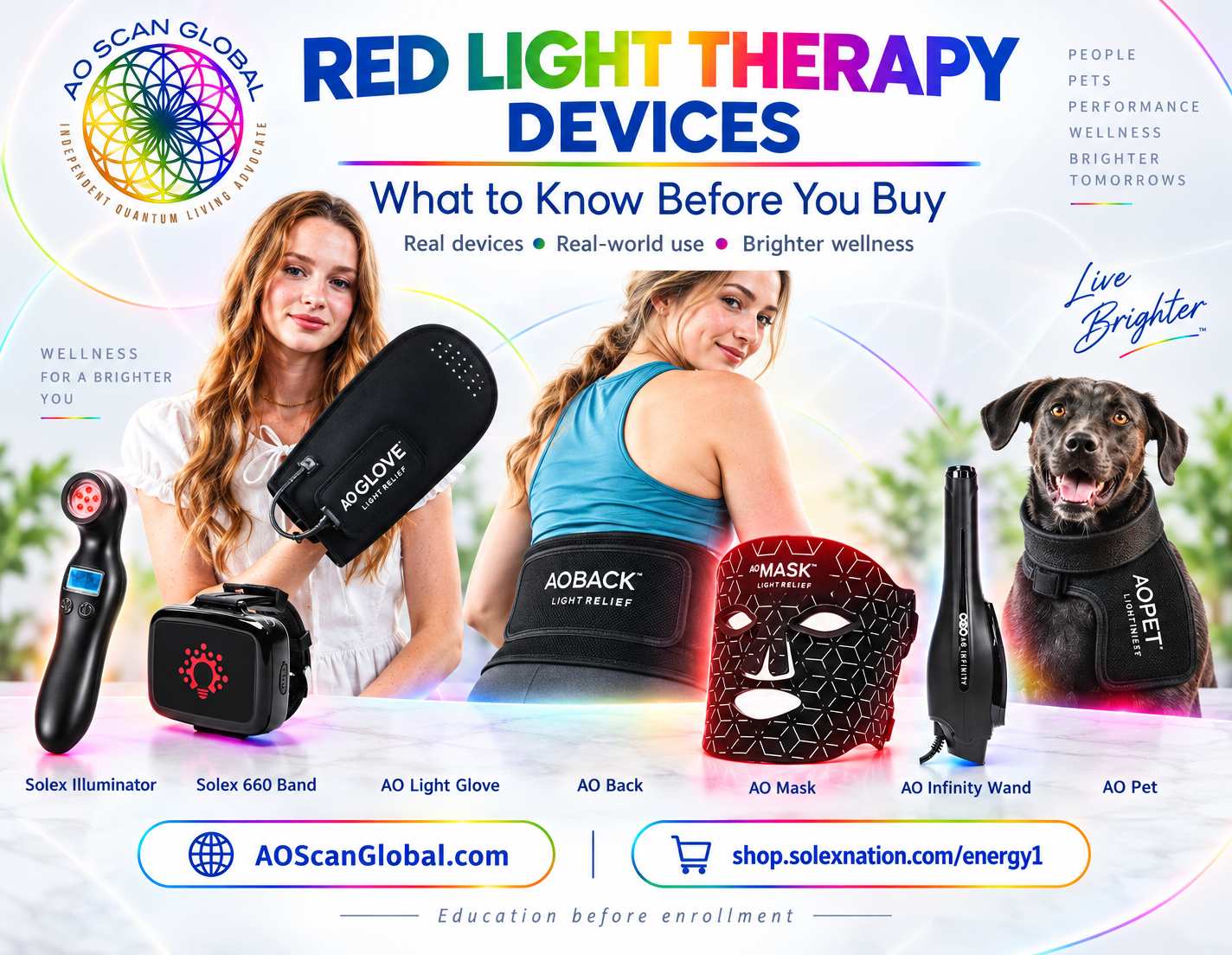
Quick Answer: Which Solex Red Light Therapy Device Fits What You Want to Do?
One thing I like about the Solex red light family is that these products are not simply six different versions of the same gadget.
They are designed around very different applications.
For targeted, handheld red light use: Solex Illuminator
The Solex Illuminator is the handheld option.
It is designed for more focused topical application rather than covering a large body area all at once. Its 660nm red-light technology makes it particularly relevant for someone interested in a portable device that can be moved directly over the area being addressed.
If you want something compact, targeted and easy to incorporate into an existing wellness or skincare routine, this is where I would start looking.
For wearable wrist application: Solex 660 Band
The Solex 660 Band takes a completely different approach.
It combines three 660nm lights and three 605nm lights in a rechargeable wrist-worn format.
Instead of manually moving a device across an area, you put the band on and let it run through its session.
For people who love wearable biohacking—and who know they will actually use something because they can put it on while answering emails, reading or working—format matters.
Sometimes the “best” device is the one that fits into your life consistently.
For hands, fingers and wrists: AO Light Glove
The AO Light Glove is much more specialized.
This is a multi-wavelength light therapy glove designed to surround the hand and wrist instead of treating them from one direction.
It incorporates red light along with additional visible and infrared wavelengths, making it quite different from a simple 660nm-only device.
For someone specifically shopping for a light therapy format for the hands, fingers or wrists, a glove makes more practical sense than trying to balance a panel or handheld device around every surface of the hand.
For a larger body area: AO Light Back
The AO Light Back moves us into larger-area wearable light therapy.
It is a flexible wrap designed for areas such as the back and abdomen, where coverage becomes more important.
That distinction matters.
A wonderful handheld device may still be terribly inconvenient if the area you want to cover is your entire lower back.
This is why I do not think red light products should be compared only by asking which one is “strongest.” You also need to ask:What body area was this device actually designed to cover?
For facial and neck light therapy: AO Mask
If skincare and facial coverage are your priority, look at the AO Mask.
The AO Mask uses multiple wavelengths rather than only one, including visible red and infrared wavelengths, and is designed to conform around the face with an additional neck component.
That means someone looking primarily for a facial light-therapy ritual may make a very different buying decision than someone looking for a wrist wearable or large body wrap.
And yes, there is one designed for pets
The AO Light Pet extends this same idea into a pet-specific format.
Again, the point is not that one device is universally “better.”
The point is that application changes the buying decision.
And before we go any further into choosing among them, it helps to understand how we got here in the first place.
Red Light Therapy Did Not Start With TikTok
If red light therapy feels like one of the hottest new biohacking trends, here is one of my favorite pieces of the story:
Light therapy has been developing for well over a century.
Modern scientific psychotherapy is commonly associated with Danish physician Niels Ryberg Finsen, whose pioneering work using concentrated light in medicine earned him the 1903 Nobel Prize in Physiology or Medicine.
Then came the laser era.
The ruby laser appeared in 1960. The helium-neon laser followed shortly afterward.
And in 1967, Hungarian physician and researcher Endre Mester conducted what became one of the foundational experiments in modern photobiomodulation.
Mester was studying laser exposure in shaved mice.
Instead of producing the effect he originally expected, he observed something unexpected:
hair in the light-exposed animals appeared to regrow faster.
He later investigated low-level laser exposure in wound healing as well.
That unexpected observation helped launch what was once called low-level laser therapy, or LLLT, and what researchers increasingly describe today as photobiomodulation, or PBM.
That history matters because red light therapy did not begin as a social-media beauty trend.
It grew out of decades of investigation into how particular wavelengths of light interact with biological tissue.
From Lasers to LEDs, Masks, Bands and Wearables
The technology continued to evolve.
Lasers were no longer the only practical way to deliver light at selected wavelengths. LEDs opened the door to larger arrays, flexible devices, masks, wearables and increasingly sophisticated at-home systems.
Today, photobiomodulation research often focuses on red wavelengths around 630–660nm and near-infrared wavelengths around 830–850nm, although many other wavelengths and combinations are being investigated.
A major 2026 review written specifically to help consumers evaluate red light therapy products emphasized something that I think every buyer should understand:
wavelength alone is not enough.
Researchers also look at factors including irradiance, fluence, treatment time, pulsing and total dose. They also describe a biphasic dose response—essentially, more light is not automatically better light.
That brings us to the first of the seven things I would look at before purchasing any red light therapy device.
1. Look at the Wavelength—Not Just the Color
Please do not buy a red light device because the bulb looks red.
That sounds almost silly, but the consumer market has become so crowded that it needs to be said.
Nanometers matter.
A 660nm red light device is delivering a defined wavelength. A device combining 635nm red light with 850nm or 1064nm infrared is delivering something different.
Neither statement automatically means “better.”
It means they were designed differently.
Generally, visible red wavelengths interact more superficially with tissue, while near-infrared wavelengths can penetrate farther. That is one reason you see different wavelength combinations depending on whether a product is designed around facial skin, hands, larger muscle areas or other applications.
This is also why I like being able to see actual wavelength specifications instead of vague phrases like “advanced red technology.”
Give me the numbers.
2. Match the Device to the Part of the Body You Actually Want to Use It On
This may be one of the most overlooked buying decisions.
Imagine purchasing a fantastic handheld device and then realizing you wanted to use red light across your entire back every night.
Technically possible?
Sure.
Convenient?
Probably not.
A facial mask, a hand glove, a wrist band, a flexible back wrap and a handheld device solve different practical problems.
So before becoming mesmerized by technical specifications, ask a much simpler question:
Where am I actually going to use this?
For example:
- Targeted topical application → Solex Illuminator
- Wrist-worn 605nm/660nm application → Solex 660 Band
- Hands and wrists → AO Light Glove
- Larger back/abdominal coverage → AO Light Back
- Face and neck → AO Mask
- Pet-specific use → AO Light Pet
Now we are shopping based on use case, not hype.
That is a much smarter way to buy wellness technology.
3. Dose Matters—And More Is Not Automatically Better
This is where red light therapy gets much more interesting than simply talking about wavelengths.
Researchers evaluate not just which wavelength is being delivered but how much light reaches the tissue and for how long.
Terms you may encounter include:
Irradiance: the amount of light power reaching a given area.
Fluence: the total light energy delivered over the session.
Treatment duration: how long the tissue is exposed.
Treatment frequency: how often sessions are repeated.
Photobiomodulation research describes a biphasic dose response, meaning the biological response does not necessarily continue improving just because exposure keeps increasing.
In plain English:
More is not always better.
That is one reason I pay attention when a manufacturer provides actual settings, treatment instructions and wavelength information rather than telling buyers simply to “use as desired.”
Good biohacking is not about doing the maximum amount of everything.
It is about understanding the tool.
And that brings us to the remaining buying factors: device quality, LEDs versus lasers, red versus near-infrared, consistency and the question almost everyone eventually asks—
Which red light therapy device gives me the best fit for my money?
That is where we will go next.
4. LEDs and Lasers Are Not Exactly the Same Thing
Another term that gets tossed around loosely in red light marketing is “laser.”
Some devices use LEDs. Some use laser diodes. Some incorporate multiple light technologies.
That distinction matters—but it does not mean one is automatically superior in every situation.
LED systems can distribute light across a much larger surface area, which is one reason they make sense in masks, gloves, wraps and pads.
Laser diodes can deliver more concentrated, targeted light, making them useful when the goal is focused application.
For example, the Solex Illuminator uses three specialized 660nm red-light laser diodes in a small handheld design.
Compare that with the AO Light Back, which uses hundreds of LEDs across a flexible wrap.
Those are two completely different approaches.
If I want to work very specifically on a small area, I may prefer the precision and portability of the Illuminator.
If I want to wrap my lower back and continue answering emails while the device does its thing, the AO Light Back makes far more practical sense.
Again:
Buy for the job you want the device to perform.
Not for the buzzword on the box.
5. Decide Whether You Want Red Light Alone or Multiple Wavelengths
Here is where the Solex product family becomes particularly interesting.
Some devices focus tightly on the red-light range.
Others combine red light with additional visible and infrared wavelengths.
Solex Illuminator: 660nm
The Solex Illuminator is built around 660nm red light.
That makes it particularly straightforward for someone who specifically wants targeted 660nm photobiomodulation rather than a multi-wavelength system.
Solex 660 Band: 605nm + 660nm
The Solex 660 Band combines:
3 lights at 605nm
3 lights at 660nm
in a rechargeable wrist-worn device.
AO Mask: Five wavelengths
The AO Mask expands far beyond red light alone and uses five wavelengths:
- Blue — 450nm
- Green — 520nm
- Red — 635nm
- Infrared — 810nm
- Deep infrared — 1064nm
The design is intended for broader face and neck coverage rather than a small point of light.
AO Light Glove, AO Light Back and AO Light Pet: Five wavelengths
These three devices use another five-wavelength combination:
- Blue — 450nm
- Green — 520nm
- Red — 635nm
- Infrared — 850nm
- Deep infrared — 1064nm
The difference is primarily where and how that light is delivered.
The AO Light Glove surrounds the hands and wrists.
The AO Light Back provides flexible coverage across larger areas of the body.
And the AO Light Pet puts the technology into a flexible pad specifically designed for animals.
This is exactly why asking, “Which Solex red light is best?” is almost the wrong question.
A better question is:
Which wavelength combination and device format best match the way I plan to use it?
6. Convenience Matters More Than Most People Admit
We biohackers love specifications.
Wavelengths.
Power.
Frequency.
Intensity.
Technology.
Give us enough numbers and we can happily disappear down a rabbit hole for hours.
But here is the part that does not sound nearly as scientific and may actually determine whether your purchase was worthwhile:
Will you use it?
A technically impressive wellness device collecting dust in your closet has an irradiance of approximately zero.
That is my unofficial scientific measurement.
If you want something you can grab and use on a targeted area, a handheld device may win.
If skincare is already part of your evening routine, a mask may integrate naturally.
If you work at a computer all day and want a hands-free wrist device, a wearable may make more sense.
If your hands are your concern, putting them inside a glove is considerably easier than trying to maneuver a panel around your fingers.
If you want broader coverage across the back, abdomen or another large area, a flexible wrap solves a problem that a tiny handheld device simply does not.
This is why form factor belongs on your buying checklist right beside wavelength and output.
Consistency is part of the equation.
7. Do Not Buy the Device With the Biggest Number—Buy the Right System
This may be the most important buying advice in this entire guide.
The wellness industry has become obsessed with bigger numbers.
More LEDs.
Higher intensity.
More wavelengths.
More power.
More everything.
But photobiomodulation is not necessarily a “more is better” technology.
Research has repeatedly discussed a biphasic dose response, meaning biological responses can change as the delivered dose changes.
That is why wavelength, irradiance, treatment time, treatment frequency and total energy all matter.
So I would be cautious of any red light device marketed almost entirely around one enormous specification.
Instead, ask:
What wavelength or wavelengths does it use?
What part of the body was it designed for?
How is the light delivered?
How long is a recommended session?
Can I realistically use it consistently?
Does the manufacturer provide actual specifications and instructions?
Is the device suited to what I am actually trying to accomplish?
That is a far more intelligent way to shop.
Solex Red Light Therapy Device Comparison
| Device | Light Technology | Best Fit | Format |
|---|---|---|---|
| Solex Illuminator | 660nm | Focused, targeted red-light application | Handheld |
| Solex 660 Band | 605nm + 660nm | People who want wearable red light at the wrist | Wrist band |
| AO Light Glove | 450, 520, 635, 850 + 1064nm | Hands, fingers and wrists | Wearable glove |
| AO Light Back | 450, 520, 635, 850 + 1064nm | Larger body areas and flexible coverage | Wrap |
| AO Mask | 450, 520, 635, 810 + 1064nm | Face and neck / skincare-focused users | Flexible mask |
| AO Light Pet | 450, 520, 635, 850 + 1064nm | Pet-specific light therapy | Flexible pet pad |
Which Red Light Therapy Device Would I Choose?
Here is how I would simplify the decision.
I want a portable, targeted 660nm device
Start with the Solex Illuminator.
It is the most obvious choice when you specifically want a handheld 660nm device that can be moved from area to area.
I want something wearable
Look at the Solex 660 Band.
Its watch-like format is designed around the wrist and combines 605nm and 660nm light.
My primary interest is my hands and wrists
The AO Light Glove is purpose-built for exactly that anatomy.
Instead of trying to aim light at one side of the hand at a time, the glove provides hands-free coverage around the hand and wrist.
“The AO Light Glove may be one of the most unique biohacking tools of 2026–2027 because it makes you think beyond the obvious. Yes, carpal tunnel comes to mind—but think about baseball pitchers, motocross riders, rock climbers, golfers, tennis and pickleball players, musicians, or anyone whose grip strength, hand comfort and recovery are essential to what they do every day. If your hands are part of your performance, this is a device worth looking at. And if you’re a multitasker like me, order two—you have two hands.”
~ Paige Maurer Wheeler
I want broad body coverage
Look at the AO Light Back.
Its flexible wrap format makes more sense for larger treatment areas than trying to cover the same space with a small handheld device.
My main interest is facial skincare
The AO Mask is the obvious product to investigate first because it is specifically designed around facial and neck coverage and incorporates five wavelengths rather than red light alone.
I want light therapy specifically designed for my dog or pet
That is exactly what the AO Light Pet was designed to do.
It is not simply a human device being repurposed for an animal; it is a flexible pet-specific format.
Where Does AO Scan Fit Into This?

If you found this article because you already follow AO Scan Global, there is an important distinction to make.
AO Scan and red light therapy are separate technologies.
AO Scan is an educational wellness technology centered around frequency-based scanning and optimization.
Photobiomodulation uses specific wavelengths of light.
One does not turn the other into a medical diagnostic or prescribe which red light product someone should use.
What they do share is the reason many people become interested in both:
They are tools for people who want to become more involved in their own wellness instead of operating entirely on guesswork.
That philosophy is a big part of what we teach at AO Scan Global.
Learn.
Measure what you can.
Understand your tools.
Pay attention to your body.
And build a wellness routine you will actually use.
If you are new to AO Scan and want to understand how the technology works, you can explore more at AOScanGlobal.com or contact AO Scan Global.
Frequently Asked Questions About Buying a Red Light Therapy Device
What is the best wavelength for red light therapy?
There is no single “best” wavelength for every purpose. Red wavelengths in approximately the 630–660nm range are widely used in photobiomodulation research, while near-infrared wavelengths such as approximately 810–850nm are frequently used when deeper tissue penetration is desired. The intended application, dose and device design all matter.
Is 660nm a good red light wavelength?
660nm is one of the most commonly discussed wavelengths in red-light photobiomodulation research. It is also the wavelength used by the Solex Illuminator and one of the two wavelengths incorporated into the Solex 660 Band.
For a deeper dive into the science, see our companion article on 660nm red light therapy and photobiomodulation.
Is near-infrared light better than red light?
Not necessarily.
They have different optical properties and may be useful for different applications. Visible red light generally acts more superficially, while near-infrared wavelengths can penetrate farther into tissue.
A multi-wavelength product may make sense when broader coverage is desired, but that does not make a single-wavelength device inferior for a focused use.
Is a laser better than an LED red light device?
Not automatically.
Laser diodes can provide focused delivery, while LED arrays make it possible to illuminate much larger areas.
The Solex Illuminator, for example, uses focused 660nm laser diodes. The AO Mask, AO Light Glove, AO Light Back and AO Light Pet use arrays of LEDs to cover substantially larger areas.
The best format depends on what you want to do with it.
How often should I use red light therapy?
Follow the instructions for the specific device rather than assuming that every photobiomodulation product should be used for the same amount of time.
Dose matters, and research does not support the idea that unlimited exposure is automatically better.
What should I look for before buying red light therapy online?
Look beyond photographs and marketing terms.
You should be able to identify the actual wavelength or wavelengths, intended treatment area, device format, basic usage instructions, manufacturer and support available after purchase.
A red bulb without meaningful specifications tells you very little.
Can I use red light therapy and AO Scan together?
They are separate wellness technologies and many people incorporate multiple wellness tools into the same lifestyle. AO Scan does not diagnose a condition or prescribe red-light treatment, and red light does not replace the functions of AO Scan.
Which Solex red light product is best for beginners?
For someone who wants a simple introduction to targeted red light, the Solex Illuminator is easy to understand because it concentrates on 660nm light in a handheld format.
Someone whose primary goal is facial skincare, back coverage, hands or wearable convenience may be better served by a device specifically designed around that use.
So, Is a Red Light Therapy Device Worth Buying?
For the right person, I think red light can be one of the easier wellness technologies to actually incorporate into daily life.
But I would not buy one simply because red light therapy is trending.
I would buy one because I understood:
the wavelength, the device, the intended application and how I was actually going to use it.
The science of photobiomodulation is fascinating—and still evolving.
What began with early psychotherapy, moved through the first lasers and the pioneering observations of Endre Mester, has now become something people can use through sophisticated handheld, wearable and flexible systems at home.
That is quite a journey for a beam of light.
And considering how rapidly this field continues to develop, I suspect we are nowhere near the end of the story.
Ready to Compare the Solex Red Light Therapy Devices?
You can explore the individual products here:
Targeted 660nm:
Solex Illuminator
Wearable wrist red light:
Solex 660 Band
Hands and wrists:
AO Light Glove
Larger body-area coverage:
AO Light Back
Face and neck:
AO Mask
Pets:
AO Light Pet
Not sure which one makes sense for you?
Contact AO Scan Global and ask. I would much rather help someone choose the tool that fits what they will actually use than sell them a device that does not.
That is what education before enrollment is supposed to look like.
Stop guessing. Start understanding your tools.
Be Well & Do Good Things
Paige Maurer Wheeler
AO Scan Global
Independent Quantum Living Advocate
About the Author
Paige Maurer Wheeler is the AO Scan Global Team Leader, expert trainer and Independent Solex Quantum Living Advocate with more than a decade of experience using AO Scan technology and educating individuals, families, wellness professionals and practitioners around the world. She is a mom, biohacker,and purveyor of goodness.
Through AOScanGlobal.com, Paige focuses on making emerging wellness technology understandable—without stripping away the science, curiosity or real-world experience that makes this field so fascinating.
Her philosophy is simple:
Scan and Know. Stop Guessing. Start Scanning.
Educational Disclaimer
This article is provided for educational and informational purposes only and is not medical advice. AO Scan is not a medical device and does not diagnose, treat, cure or prevent disease. Solex red light and wellness products are not intended to diagnose, treat, cure or prevent disease. Individual responses to photobiomodulation and wellness technologies vary. Follow the manufacturer’s instructions and appropriate professional guidance for your individual circumstances.