


What if some of the emotional patterns we have accepted as part of our personality are really invitations to understand ourselves more deeply?
Have you ever wondered why a particular situation triggers an emotional reaction that seems much bigger than the moment itself?
Maybe it is a conversation with a family member.
A recurring frustration in a relationship.
A fear that seems to appear without warning.
Or perhaps you have noticed that even after a challenging experience is over, your body still reacts with tension, uneasiness, or heightened alertness when something reminds you of it.
We often describe these patterns with familiar phrases:
“That’s just the way I am.”
“I’ve always been anxious about that.”
“My father reacted that way, and now I do too.”
But what if there were more to explore?
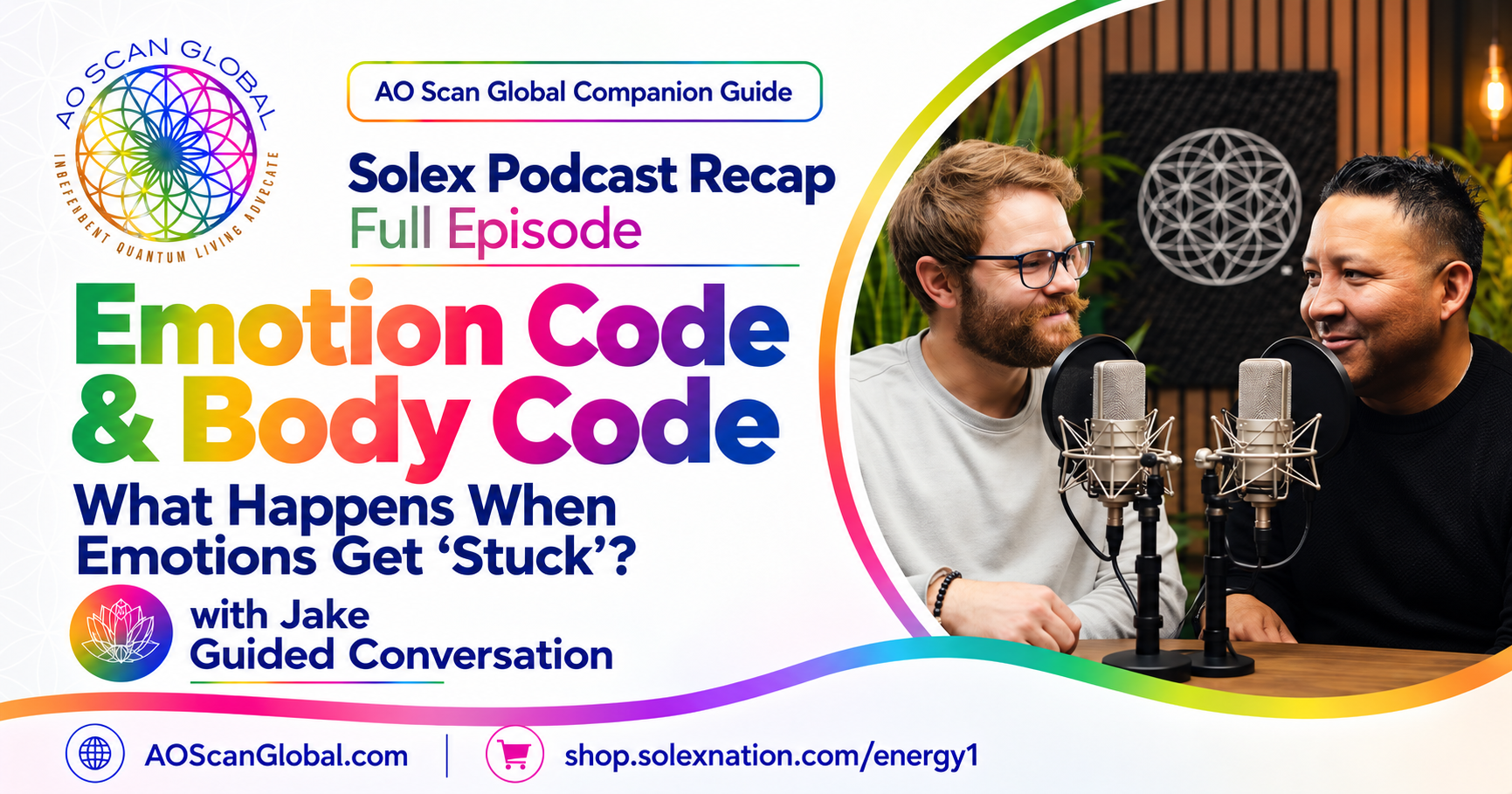
That question is at the heart of the October 12, 2026, episode of the Solex Podcast, where host Jake welcomes Emanuel Z for an engaging discussion about trapped emotions, emotional baggage, The Emotion Code, The Body Code, and a concept known as the Heart-Wall.
As someone who has spent more than a decade exploring AO Scan frequency wellness technology and educating practitioners around the world, I found the conversation especially interesting.
Why?
Because it encourages us to look beyond one isolated wellness concern and consider the larger picture of our experiences, habits, emotional responses, and personal well-being.
And as many AO Scan users know, exploring those patterns is one of the reasons we become interested in holistic wellness technology in the first place.
Let’s look at what Emanuel shared, what the science of emotional stress tells us, and how these ideas connect with some of the educational tools available within AO Scan.
Meet Emanuel: From Personal Challenges to Energy Wellness
Emanuel’s journey into The Emotion Code did not begin with a conventional career in medicine or psychology.
During the podcast, he explains that both of his parents were oncologists and hematologists, although they had different perspectives on health.
His father leaned toward conventional medicine, while his mother was interested in holistic approaches, including acupuncture and other traditional wellness practices.
Growing up around these differing philosophies helped shape his openness to exploring alternative approaches later in life.
In approximately 2015, Emanuel found himself navigating a challenging personal period.
He began reading The Emotion Code, developed by Dr. Bradley Nelson.
What started as personal curiosity became a new professional direction.
Emanuel describes becoming increasingly interested in the idea that unresolved emotional experiences could influence how people feel, relate to others, and respond to life’s challenges.
He subsequently began working with clients using The Emotion Code and The Body Code methodologies.
During the conversation, Emanuel shares personal observations and client experiences from years of practice, including remote sessions and his interpretation of emotional patterns.
These are his experiences and beliefs within an energy-wellness framework. They are not clinical evidence that the methods diagnose or treat medical or psychological conditions.
One interesting part of his story is that he openly admits he was initially skeptical of some of the concepts.
That willingness to ask questions makes this episode particularly relatable.
After all, exploring something unfamiliar does not require abandoning critical thinking.
Curiosity and discernment can work beautifully together.
What Are Trapped Emotions?
The term trapped emotions is central to The Emotion Code methodology.
According to the model developed by Dr. Bradley Nelson, intense or unresolved emotional experiences may leave behind energetic imprints, which practitioners believe can influence a person’s emotional or physical experience.
Within this framework, those imprints are described as trapped emotions.
Emanuel discusses several proposed categories during the podcast, including emotions connected to personal experiences, relationships, family history, and what the methodology describes as inherited or absorbed emotions.
He also explores how practitioners attempt to identify these patterns using muscle testing.
Are Trapped Emotions Scientifically Established?
This is an important distinction.
The idea that specific emotions remain physically lodged in the body as discrete energy objects has not been established by mainstream scientific research.
Likewise, there is insufficient reliable clinical evidence that muscle testing can identify hidden emotional imprints or that the Emotion Code process can treat diseases.
However, there is substantial scientific evidence that emotional stress can influence physical processes.
The American Psychological Association explains that stress affects multiple body systems, including the nervous, cardiovascular, digestive, endocrine, and musculoskeletal systems.
The National Institute of Mental Health also recognizes that prolonged stress and anxiety can be associated with changes in sleep, muscle tension, pain, and other aspects of well-being.
In other words, the general relationship between emotional experiences and physical responses is real and well documented.
What remains unproven is the specific energetic explanation proposed by The Emotion Code.
For anyone interested in holistic wellness, understanding that distinction allows us to explore ideas responsibly while appreciating what modern science has already established.
The Mind-Body Connection: Why Emotional Experiences Matter
One of the most valuable themes in the podcast is the invitation to pay closer attention to our emotional lives.
Consider what happens during a stressful moment.
Your breathing may change.
Your heart may beat faster.
Your shoulders may tighten.
Your attention may become focused on a perceived threat.
These reactions involve complex interactions among the brain, autonomic nervous system, hormones, and other physiological systems.
They are part of the body’s normal stress response.
But what happens when stress continues over days, months, or even years?
Research recognizes that chronic stress can contribute to sleep disturbances, persistent tension, and changes in health and well-being.
According to the CDC’s guidance on managing stress, long-term stress deserves attention because of its potential effects on mental and physical health.
This does not mean emotional distress causes every illness.
Nor does it mean that someone experiencing a medical condition has somehow created it through negative thoughts, unprocessed grief, or emotional trauma.
Health is far more complicated than that.
Genetics, environment, infection, physiology, nutrition, medications, lifestyle, and many other factors contribute to health outcomes.
Nevertheless, emotional well-being deserves consideration within a comprehensive wellness routine.
And this is where I believe the podcast raises a worthwhile question:
Are we giving our emotional well-being the same regular attention we give nutrition, movement, supplementation, and physical fitness?
For many people, the answer may be no.
Understanding The Emotion Code and The Body Code
Although the terms are often mentioned together, The Emotion Code and The Body Code refer to two related but distinct systems developed by Dr. Bradley Nelson.
What Is The Emotion Code?
The Emotion Code is an alternative energy-wellness methodology centered on identifying and attempting to release what practitioners call trapped emotions.
Practitioners commonly use muscle testing, an emotion chart, and a magnet-based procedure associated with a traditional meridian pathway.
Emanuel describes these steps during the podcast, including the use of self-testing and working with another practitioner.
The method is often presented as a way to explore emotional baggage without having to verbally recount every difficult life experience.
While participants may report personal benefits, such reports are subjective and do not establish that the method releases measurable stored emotional energy.
What Is The Body Code?
The Body Code expands the same general philosophy into additional categories of proposed energetic imbalance.
Within that system, practitioners explore a broader range of emotional, structural, nutritional, energetic, and environmental concepts.
The important distinction is that these categories are part of the Body Code framework, not medically validated diagnostic findings.
Neither The Emotion Code nor The Body Code should replace qualified psychological counseling, medical assessment, or treatment.
They are best understood as alternative approaches that some individuals choose to explore for personal wellness and reflection.
The Heart-Wall: One of the Podcast’s Most Thought-Provoking Concepts
One of the most memorable portions of Jake’s conversation with Emanuel centers on the concept called the Heart-Wall.
Within The Emotion Code philosophy, a Heart-Wall is described as a protective accumulation of trapped emotional energies surrounding the heart.
Emanuel uses this concept to discuss emotional guardedness, difficulty receiving affection, relationship barriers, and the feeling of becoming disconnected from one’s natural enthusiasm for life.
His own description of feeling emotionally numb during a challenging period is especially personal.
He compares the experience of being emotionally guarded to living inside a protective shelter while the beauty of life continues outside.
It is a compelling metaphor.
Even without accepting the Heart-Wall as a literal energetic structure, many people can relate to the underlying human experience.
After disappointment, grief, betrayal, or prolonged stress, some individuals become more guarded.
They may find it difficult to trust.
They may hesitate to be vulnerable.
They may struggle to express affection as freely as they once did.
Psychology offers established ways to understand some of these experiences through attachment, learned coping strategies, trauma responses, and emotional regulation.
The Heart-Wall is a different, alternative explanatory model and has not been established as an anatomical or physiological structure.
Still, the podcast prompts an interesting opportunity for self-reflection:
Are some of our emotional defenses still helping us, or have they become habits that deserve closer attention?
That is a question worth exploring thoughtfully, with compassion for ourselves and the people around us.
From Emotional Awareness to AO Scan Inner Voice
This is where I want to bring the conversation back to another area I find fascinating: AO Scan’s Inner Voice technology.
Emanuel briefly mentions AO Scan during his conversation with Jake, referencing his wife’s use of the technology and his interest in its emotional-wellness features.
For those unfamiliar with the AO Scan platform, Inner Voice is one of several modules available within this educational frequency-wellness system.
Inner Voice uses a short voice recording, approximately 10 seconds, to generate information within AO Scan’s proprietary emotional-frequency framework.
The application presents categories of emotional patterns and provides associated tones and wellness-oriented content for the user to explore.
Some individuals incorporate Inner Voice alongside journaling, reflection, breathing exercises, and other personal wellness routines.
Another complementary AO Scan feature is MindSync, which allows users to explore personalized affirmations, mindset themes, and related frequency-based wellness content.
It is important to understand that these are educational and self-exploration tools.
AO Scan does not clinically measure or diagnose trapped emotions, psychological disorders, trauma, or physical disease. Voice-based frequency reports are not established substitutes for validated psychological assessments.
But for people who enjoy structured self-reflection, the technology offers an interesting additional way to engage with their personal wellness routines.
Learn more in my AO Scan Inner Voice and MindSync guide.
Emotional Triggers, Relationships, and the Person Beneath the Patterns
One of the most interesting moments in Jake’s conversation with Emanuel Zevallos is the discussion about how we perceive other people.
We all know someone who seems to react strongly to certain situations.
Perhaps they become defensive during difficult conversations.
Maybe they withdraw when emotions become uncomfortable.
Or they have difficulty accepting affection, receiving constructive feedback, or expressing vulnerability.
It can be easy to label these behaviors as personality traits.
But Emanuel invites listeners to consider whether some of these patterns reflect emotional experiences and protective responses developed earlier in life.
That is an important distinction.
Our personalities are shaped by a complex combination of biological, psychological, social, and environmental influences. Past experiences can also affect how we respond to stress, interpret situations, and interact with others.
Within The Emotion Code framework, Emanuel describes some of these experiences as trapped emotions or energetic patterns.
Although the proposed energetic explanation is not scientifically established, the broader idea that experiences can influence behavioral responses is consistent with psychological research.
And this raises a meaningful question:
What might change in our relationships if we became more curious about another person’s emotional experiences instead of immediately judging their behavior?
Compassion does not mean accepting harmful behavior.
It means recognizing that understanding someone’s experiences can sometimes help us approach a difficult situation more constructively.
Emotional Baggage and the Heart-Wall in Relationships
During the podcast, Emanuel returns to the Heart-Wall concept, explaining how he believes emotional experiences can create barriers to feeling connected with other people.
He describes examples involving affection, communication, and the ability to feel emotionally present in relationships.
Within The Emotion Code system, the Heart-Wall is understood as an energetic protective mechanism.
There is no established scientific evidence that such a physical or energetic wall surrounds the heart.
However, the metaphor can still provide an opportunity for reflection.
Think about how relationships sometimes change following disappointment, grief, betrayal, or prolonged periods of stress.
A person may become more cautious about sharing their feelings.
Someone who previously expressed affection freely may become less emotionally available.
Another person may interpret neutral conversations as criticism because of earlier experiences.
These patterns can have many explanations, including learned coping strategies and changes in emotional regulation.
Understanding and addressing them may involve communication, supportive relationships, counseling, or other evidence-informed approaches.
What I appreciate about this part of the Solex Podcast is that it encourages listeners to ask a different kind of question.
Instead of asking only, “Why does this person keep reacting this way?” we might also ask:
“What experiences could be influencing this reaction, and how can we communicate more effectively?”
That is an empowering shift in perspective.
One of My Favorite Takeaways: Give People Permission to Feel
Around the later portion of the interview, the conversation turns toward emotional expression and how families respond when someone is experiencing difficult feelings.
Emanuel shares an important observation about his own parenting.
Sometimes, he says, his instinct is to move immediately into solving a problem.
But he has been learning that his children may need something else first.
They need someone to listen.
They need room to express themselves.
And they need to feel that their emotions are being acknowledged rather than immediately corrected.
Emanuel discusses how his wife, Jess, has helped remind him of the importance of allowing that emotional space.
I found this particularly meaningful.
Many of us genuinely want to help the people we love. When someone is hurting, our first instinct may be to offer a solution.
But not every emotional experience needs to be immediately fixed.
Sometimes a person benefits from being heard and understood before discussing next steps.
That can be especially important in parenting, partnerships, friendships, and caregiving relationships.
Emotional wellness involves more than trying to eliminate uncomfortable feelings. It also involves learning how to recognize, understand, and respond to them.
For parents exploring alternative emotional-wellness practices, it is equally important to respect children’s comfort and developing autonomy. Such practices should not be presented as substitutes for qualified pediatric or mental-health care.
Can Emotional Patterns Be Passed Through Generations?
Emanuel also explores the idea of inherited emotions.
Within The Emotion Code philosophy, practitioners believe certain emotional patterns may be energetically inherited from previous generations.
This concept is distinct from what scientific researchers mean when they study intergenerational influences.
Research has explored several ways that emotional and behavioral patterns may occur across generations.
Children may learn ways of responding to stress through family interactions.
Experiences within a household can influence expectations about emotional expression, conflict, and safety.
Genetic factors can contribute to individual differences in temperament and vulnerability to certain mental-health conditions.
Researchers have also investigated whether some effects of stress may involve epigenetic mechanisms, although evidence for direct transmission of specific emotional experiences across human generations remains limited and complex.
None of these findings establish that an identifiable trapped emotion is energetically inherited from a distant ancestor.
Nevertheless, exploring family patterns can provide valuable opportunities for self-awareness.
Perhaps a family has historically avoided discussing difficult emotions.
Maybe several generations have experienced similar expectations around success, perfectionism, or emotional expression.
Recognizing these patterns can help us make more intentional choices.
And that brings us to one of the most interesting possibilities in personal wellness:
We may not control every experience that shaped us, but we can learn new ways to respond to the experiences we encounter today.
What Does Muscle Testing Have to Do With The Emotion Code?
Muscle testing is another important topic in the podcast.
Emanuel describes using muscle testing as part of his process for exploring what he considers emotional imbalances.
Within The Emotion Code and Body Code methodologies, practitioners interpret particular muscle responses as indicators that help them navigate charts and identify proposed energetic patterns.
He also discusses magnet-based techniques traditionally used within the system.
It is important to understand that muscle testing for detecting trapped emotions is not an established medical diagnostic method.
A person’s muscle response may be affected by applied force, fatigue, expectation, positioning, and other factors. There is insufficient reliable evidence that this method can accurately identify particular emotions, inherited trauma, or hidden medical conditions.
For those who are curious about these techniques, maintaining this distinction is essential.
Personal experiences can inspire curiosity.
But objective medical claims require reproducible scientific evidence.
The most responsible wellness conversations make room for both exploration and discernment.
AO Scan Inner Voice: A Different Approach to Emotional Self-Reflection
Now let’s connect the Solex Podcast discussion with one of my favorite features of AO Scan technology: Inner Voice.
As an AO Scan practitioner and trainer for more than a decade, I have found that many people become especially interested in the emotional-wellness features when they first explore the platform.
We are often accustomed to thinking about wellness in terms of nutrition, movement, sleep, and physical fitness.
But what about our emotional state?
How often do we intentionally check in with ourselves?
This is where Inner Voice can be incorporated into an educational personal-wellness routine.
How Does AO Scan Inner Voice Work?
Inner Voice begins with a short voice recording, typically about 10 seconds.
Your voice produces an acoustic signal containing measurable sound frequencies and harmonics.
AO Scan analyzes that recording within its proprietary system and associates the vocal-frequency patterns with categories used in the Inner Voice report.
The platform then generates personalized audio harmonics for listening.
For me, one of the enjoyable aspects of using Inner Voice is its simplicity.
I can complete a short recording, review the information, and incorporate the resulting audio into my daily routine.
Sometimes I listen during a walk.
Other times, I use the experience as an opportunity to reflect on how I have been feeling.
The key distinction is that AO Scan’s emotional categories are not validated clinical measurements of a person’s psychological state.
The software cannot establish that someone has unresolved trauma, identify a psychiatric diagnosis, or prove that a particular emotion is stored within an organ.
Instead, Inner Voice offers a proprietary frequency-based framework that some users enjoy as a prompt for personal awareness and reflection.
Learn more about the technology in my guide: What Does AO Scan Measure?
AO MindSync: Bringing Positive Intentions Into Your Wellness Routine
Another AO Scan feature that connects naturally with this podcast conversation is AO MindSync.
Where Inner Voice focuses on its proprietary vocal-frequency analysis, MindSync provides a way to incorporate customized affirmations and audio into a mindset routine.
Users can create or select affirmations that reflect personal intentions.
Examples might include:
- I give myself permission to acknowledge my emotions.
- I can respond thoughtfully rather than react automatically.
- I welcome healthy communication into my relationships.
- I am learning to approach challenges with patience and compassion.
- I make space for calm, connection, and personal growth.
These statements are not medical treatments.
Nor should affirmations be used to deny difficult circumstances or suppress genuine emotional experiences.
Instead, they can serve as reminders of the habits and values we want to practice.
Some people enjoy combining affirmations with meditation, journaling, breathing exercises, or a quiet morning routine.
MindSync provides a technology-based way to personalize that experience.
Explore the detailed guide: AO MindSync: Your Voice, Your Power
A Simple Emotional Wellness Routine You Can Try
One message that came through strongly in this Solex Podcast episode is that personal wellness benefits from regular attention.
We do not have to wait until we feel overwhelmed before checking in with ourselves.
Here is a simple routine that combines established self-care practices with optional AO Scan tools.
Step 1: Begin With Awareness
Before checking your phone or diving into the day’s responsibilities, take a moment to consider how you are feeling.
Are you calm?
Rested?
Excited?
Overwhelmed?
There is no need to judge the answer.
The goal is simply to become more aware.
Step 2: Explore Your Inner Voice
If you are an AO Scan user, record your short Inner Voice sample.
Review the generated report as an educational wellness prompt rather than a medical or psychological assessment.
Consider whether any of the themes encourage useful personal reflection.
Step 3: Choose an Intention
Select a simple intention for the day.
For example:
“Today, I will respond with patience.”
Or:
“I can recognize my feelings without letting them control every decision.”
MindSync can be used to create a personalized affirmation audio experience around this intention.
Step 4: Support Your Nervous System
Incorporate a practical relaxation activity.
This might include a short walk, comfortable breathing exercises, mindfulness, time outdoors, or another activity you enjoy.
The National Institutes of Health recognizes that practices such as regular exercise, adequate sleep, social support, and relaxation techniques can contribute to emotional well-being.
Step 5: Reflect Without Judgment
At the end of the day, ask yourself:
What did I notice about my emotional responses?
Was there a moment when I paused instead of reacting?
Did I communicate clearly?
What would I like to approach differently tomorrow?
Over time, this type of reflection can help you become more familiar with your habits and choices.
And sometimes that is the beginning of meaningful personal change.
Can AO Scan and The Emotion Code Be Used Together?
This is a question that some holistic wellness practitioners may naturally ask after listening to the episode.
AO Scan and The Emotion Code are separate systems with different procedures and underlying frameworks.
The Emotion Code focuses on a practitioner’s interpretation of trapped emotions through muscle testing and related techniques.
AO Scan provides proprietary frequency-based reports and features such as Inner Voice and MindSync.
A practitioner who uses both may choose to incorporate them into a broader educational wellness conversation.
However, neither system has been clinically validated to diagnose trapped emotions or treat medical and psychological conditions. Using the systems together does not establish greater accuracy or therapeutic effectiveness.
Appropriate professional boundaries are essential.
Practitioners should explain the limitations of each tool, obtain informed consent, protect personal information, and refer clients to licensed healthcare professionals when medical or mental-health concerns arise.
For professionals who are interested in learning how AO Scan works within its intended non-diagnostic wellness framework, I offer demonstrations and educational training through AO Scan Global.
What the Solex Podcast Reminded Me About Whole-Person Wellness
What I particularly enjoyed about Jake’s conversation with Emanuel was the emphasis on seeing people as more than their most difficult moments.
It is easy to define ourselves through habits, struggles, or experiences we have carried for years.
But we are also capable of learning.
We can build healthier communication habits.
We can become more aware of our emotional responses.
We can seek support when we need it.
And we can become more intentional about the environments and relationships we create.
Emanuel’s approach comes from an alternative energy-wellness philosophy.
My work with AO Scan comes from a different technological framework.
And contemporary psychology and medicine offer additional, evidence-based perspectives on how emotions, stress, and behavior interact.
These perspectives are not scientifically interchangeable.
Yet the broader conversation can still inspire valuable questions about self-awareness, compassion, and our personal wellness routines.
For me, that is the real value of a thoughtful discussion.
It encourages us to remain curious, keep learning, and explore approaches with an understanding of both their possibilities and their limitations.
Frequently Asked Questions About Trapped Emotions, The Emotion Code, and AO Scan
What are trapped emotions?
Trapped emotions are proposed energetic imprints within The Emotion Code methodology. Practitioners believe these imprints may result from emotional experiences and influence well-being. This specific mechanism has not been scientifically established.
Is The Emotion Code the same as The Body Code?
No. The Emotion Code focuses primarily on identifying and attempting to release trapped emotions. The Body Code is a broader alternative methodology that considers additional categories of proposed energetic imbalance.
What is a Heart-Wall?
The Heart-Wall is a concept from The Emotion Code describing what practitioners believe is a protective accumulation of emotional energy around the heart. It is not a medically established structure.
Can emotional stress affect the physical body?
Yes. Scientific research has demonstrated that stress can affect the nervous, cardiovascular, digestive, endocrine, and other systems. Chronic stress may contribute to physical symptoms and affect overall well-being.
This does not mean every physical illness has an emotional cause.
Can AO Scan detect trapped emotions?
AO Scan Inner Voice produces emotional-frequency categories within its proprietary wellness framework. It is not scientifically validated to detect trapped emotions, diagnose trauma, or measure a person’s clinical emotional state.
What is the difference between AO Scan Inner Voice and MindSync?
Inner Voice analyzes a short vocal recording and produces a proprietary frequency-based report and associated audio harmonics.
MindSync is designed around personalized affirmations and audio for mindset-related wellness routines.
Both are non-diagnostic wellness features.
Can I use AO Scan in a holistic wellness practice?
Yes, AO Scan can be incorporated as an educational frequency-wellness tool, provided its capabilities and limitations are accurately explained. It should not be represented as a medical diagnostic device or a replacement for qualified healthcare services.
Where can I purchase AO Scan technology?
AO Scan subscriptions and related Solex products are available through the AO Scan Global official shopping link.
Explore AO Scan Technology With AO Scan Global
Are you curious about adding AO Scan technology to your personal wellness routine or professional practice?
Whether you are a biohacker, holistic practitioner, wellness educator, or someone who simply enjoys exploring emerging wellness tools, AO Scan Global provides education, demonstrations, and training to help you understand the system.
The AO Scan platform includes a variety of educational modules and features, including Inner Voice, MindSync, Vitals, Body Systems, Comprehensive, and frequency-based wellness tools.
As an independent Quantum Living Advocate, global team leader, and experienced AO Scan trainer, I enjoy helping new users become comfortable with the technology and learn how its different modules work.
Stop Guessing. Start Scanning.
Ready to explore?
Shop AO Scan Technology and Solex Products
Request an AO Scan Demonstration or Contact Me
Explore More AO Scan Education and Training
Final Thoughts: Awareness Is a Powerful Place to Begin
The October 12, 2026, Solex Podcast with Jake and Emanuel Zevallos offers an engaging introduction to The Emotion Code, The Body Code, the Heart-Wall, and the broader conversation about emotional wellness.
Some of Emanuel’s ideas are based on alternative energy-healing beliefs that have not been clinically validated.
But the episode also explores something deeply relatable: the importance of understanding our emotions, improving communication, and creating space for ourselves and others to grow.
When we combine curiosity with sound information and thoughtful self-reflection, we give ourselves more opportunities to make intentional wellness choices.
And that is a conversation I am always happy to continue.
Be Well & Do Good Things.
Paige Maurer Wheeler
AO Scan Global Team Leader & Expert Trainer
Independent Quantum Living Advocate
AOScanGlobal.com
Educational Disclaimer: This article is for educational and informational purposes only. AO Scan, The Emotion Code, and The Body Code are not substitutes for medical diagnosis, treatment, psychotherapy, or other qualified healthcare. References to energetic patterns, frequency balancing, trapped emotions, or emotional release describe the respective systems’ proprietary or alternative wellness frameworks and are not established clinical findings. Personal testimonials are not proof of therapeutic effectiveness.